
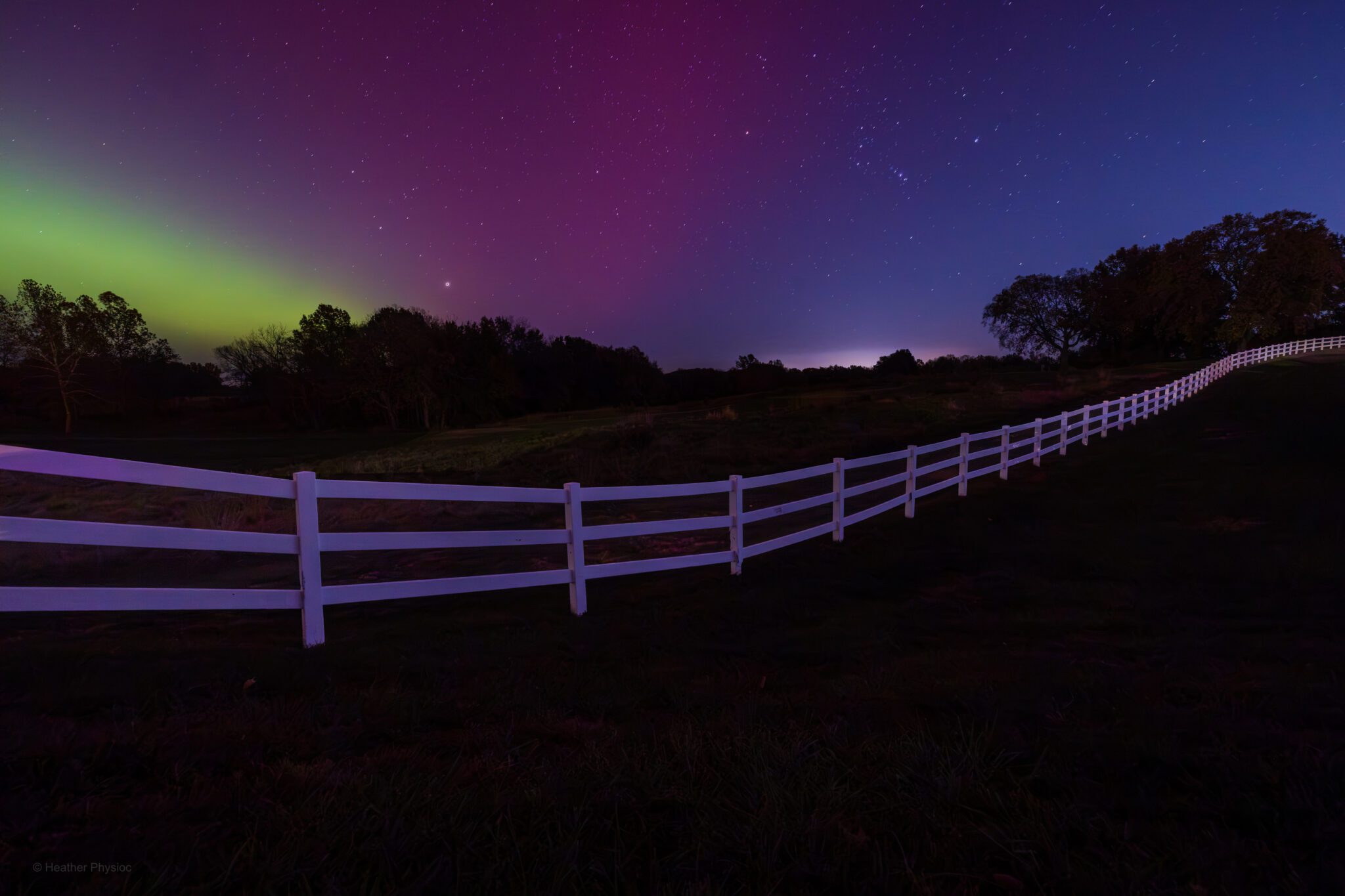
The Northern Lights (Aurora Borealis) are a rare and special treat for Kansas City. Sitting at Latitude ~39°N, KC is much further south than the typical viewing zones, like Canada or Alaska, and sightings of the aurora borealis are extremely rare. In an average decade, visible auroras might occur fewer than three times.
However, we are currently in a period of high solar activity that makes these sightings more frequent than usual. At the time of this writing, we are in the peak of Solar Cycle 25 (Solar Maximum). During this two- to three-year window, the sun is unusually active, making it a particularly exciting time for aurora chasers in Missouri and Kansas.
Here’s what you need to know about finding and photographing the Aurora Borealis when we are lucky enough to see it in the Midwest.
- What are the Northern Lights?
- Can you see the Northern Lights from Kansas City?
- Where should you go around the Kansas City metro area for your best chances of seeing the Northern Lights?
- When can you see the Northern Lights in KC?
- When was the last time Kansas City saw the Northern Lights?
- How can you spot the Northern Lights in the Kansas City area?
- How can you photograph the Northern Lights successfully?
What are the Northern Lights?
The Northern Lights are a natural light display in the Earth’s sky caused by charged particles from the Sun interacting with gases in our upper atmosphere. The Sun occasionally releases huge bursts of energy and particles (solar wind, flares, or coronal mass ejections). When those particles reach Earth, they are guided by the planet’s magnetic field toward the north and south poles. As they collide with atmospheric gases high above Earth, they emit light. The result is a glowing curtain, arc, or ripple of color that can move or “dance” across the sky.
The colors you see may come from different gasses or altitudes:
- Green or red light suggests Oxygen (O)
- Blue or purple light suggests Nitrogen (N)
The phenomenon is most commonly seen in high-latitude places like Alaska, Canada, or Scandinavia. In places farther south, like my hometown of Kansas City, the lights are only visible during super strong solar storms. During an extreme G5 storm, as the one seen in May 2024, viewing extended as far south as northern Texas.
Can you see the Northern Lights from Kansas City?
The aurora borealis may look a bit different in Missouri. What we may rarely be fortunate enough to see is usually the upper edge of the aurora, the “auroral curtain,” which tends to look red or pink near the horizon, rather than bright green overhead arcs. Because seeing the Northern Lights in KC is so rare, it’s easy to confuse the celestial phenomenon for city light pollution, reflected cloud glow from stadium lights or parking lots, distant weather or storm lighting, wildfire smoke or sunset afterglow.
Where should you go around the Kansas City metro area for your best chances of seeing the Northern Lights?
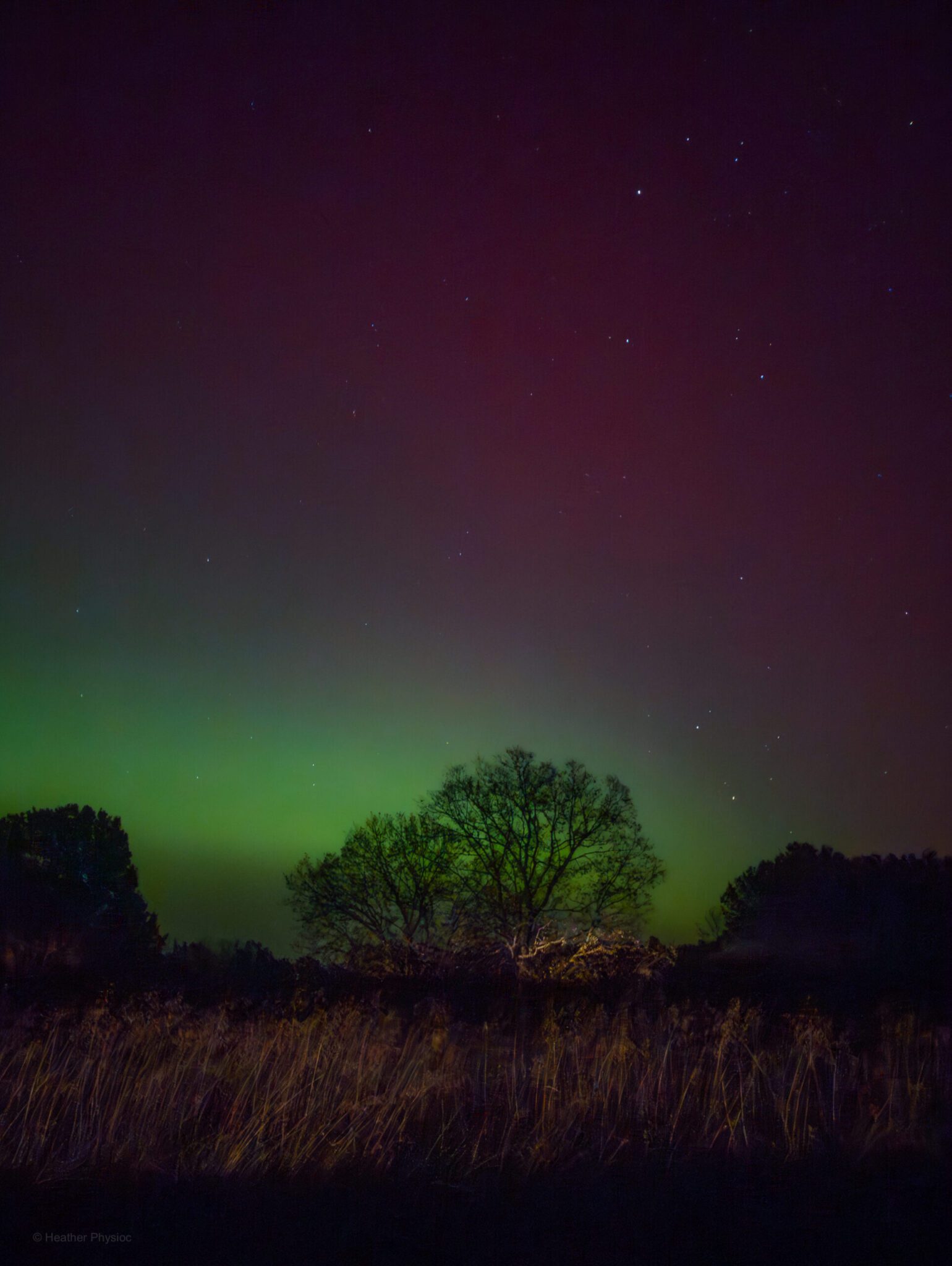
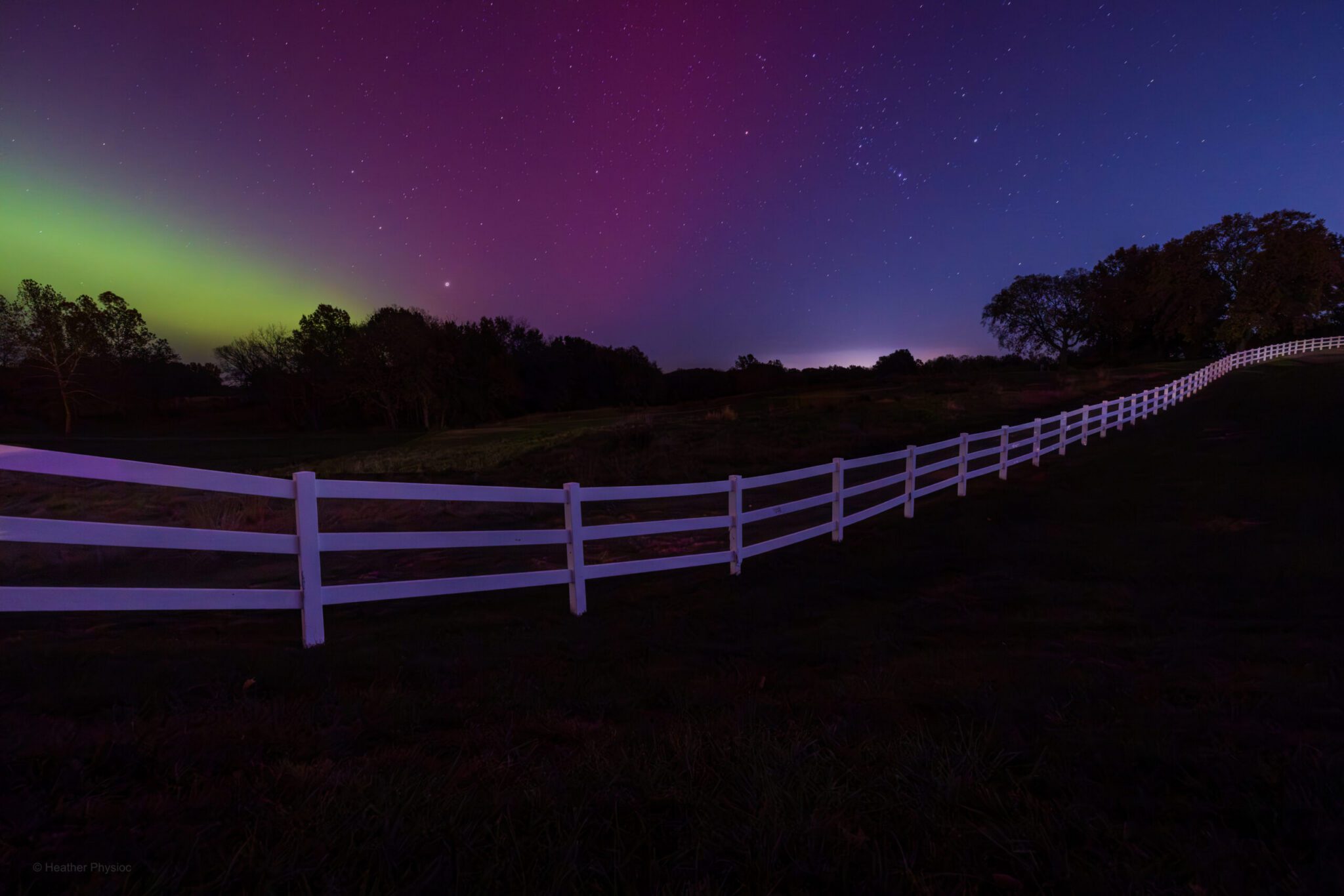
Here is a map I continue to cultivate of recommended spots with the darkest skies possible in and around Kansas City – just in case aurora luck strikes. This helps me find the darkest skies possible in and around the Kansas City metro area when we get lucky enough to experience cosmic phenomena like the Northern Lights. (I took the aurora borealis photos in this post near Smithville Lake.)
When can you see the Northern Lights in KC?
Best Seasons to View the Northern Lights
The Northern Lights aren’t tied to a particular season the way meteor showers or constellations are. The aurora depends on solar activity, not Earth’s calendar. That said, a few seasonal realities affect visibility in Kansas City. Winter and fall are easier to spot the lights when activity is strong enough, simply because nights are longer and darker. Spring and fall equinoxes often happen to coincide with stronger geomagnetic activity, but it’s not guaranteed. Summer sightings are possible, but it is extremely rare, and short nights and humidity would reduce visibility.
Best Time of Night to View the Northern Lights
Statistically, the aurora is most active between 10 p.m. and 2 a.m., because our side of Earth is aligned with the incoming bursts or streams of solar wind. However, our most recent sightings were special – the events peaked earlier in the evening, around 8 p.m. to 10 p.m. Some have reported that strong activity has started as early as 7 p.m., and it ultimately fades by midnight. We don’t get to control when the lights happen, but note that visibility may be better during times of a new moon, or when the moon is below the horizon. Note that displays can come and go multiple times throughout the night – and even within minutes.
Check the Aurora Borealis Forecast
A number of websites and apps track the aurora borealis and solar activity and can alert you to opportunities to see it. Here are a few to try:
- Aurora Dashboard from the Space Weather Prediction Center from the National Oceaning & Atmospheric Administration (NOAA)
- Real-time auroral and solar activity from SpaceWeatherLive
- My Aurora Forecast & Alerts app
The metric to watch is the “Kp Index,” which we want to be 7 or higher for Kansas City visibility. You can also look for a “Bz” (magnetic field) that is pointing South (a negative number).
When was the last time Kansas City saw the Northern Lights?
In November 2025, the Earth was impacted by multiple Coronal Mass Ejections (CMEs) that merged and launched from the sun by X-class solar flares on November 9 and 10. The storm reached G4 (Severe) levels on the NOAA scale. This is one step below the “Extreme” G5 rating seen in the historic storms of 2024.
Because the storm was so strong (Kp index peaking around 8), the “auroral oval” was pushed far south. In the Kansas City metro, many of us saw red and pink pillars on the northern horizon, though it was far more vivid on our smartphone cameras.
How can you spot the Northern Lights in the Kansas City area?
1. Come prepared.
Dress warmly and in layers, with good shoes. You will want a headlamp or flashlight, ideally with red light mode that preserves night vision and doesn’t blind other photographers. Charge your camera batteries and devices, with spares or power on-hand. Tell someone where you’re going – especially if you are driving to rural areas alone. Park only in legal, safe pull-offs that are not spilling over into roadways or blocking drives.
2. Go north of the KC light dome.
This is the single most important thing you can do. You need to look north to see the Northern Lights, so put the Kansas City glow to the south of you by going north of town. This will give you a darker northern horizon. The aurora often appears very low on the northern horizon here, so even a mildly bright city glow can drown it out. Specifically, get north of Kansas City International Airport, and even a little northwest if you can.
3. Find the darkest area possible.
Though we do not have any certified Dark Sky spaces in Kansas City (the nearest is Thousand Hills State Park in Kirksville, Missouri, about three hours away), you should still aim for the darkest spots possible with as little city and ground light as you can reach.
4. Test the scene with your camera or phone.
The colors and bands of the Northern Lights may not be easily visible to the naked eye in Kansas City and surrounding areas because we’re on the edge of the auroral curtain. In fact, locals often mistake it for ground light or haze. Cameras are much more sensitive to light than human retinas, and artificial sensor amplification on cameras often exaggerates color intensity compared with the naked eye, so a quick snapshot on your phone can reveal the pink or green of the aurora.
Here’s how to do it:
- Set your camera to night mode or long exposure.
- Point your camera or smartphone north.
- Take a 3 to 10 second exposure if you can – longer if you can.
- Look for signs of the green or pink auroras.
5. Let your eyes adapt.
If your camera picks up the Northern Lights, put the phone away and let your eyes adjust to the dark, at least 20 minutes. (This can be more challenging when you’re in the city and cars are driving by.) Watch for faint pillars of gray or red light dancing, or slightly brighter spots in the sky.
How can you photograph the Northern Lights successfully?
Anyone can capture the magic of the Northern Lights on a cell phone camera, or real camera if you are lucky enough to have one. I am far from an astrophotography expert, but here are a few Northern Lights photography tips I can share:
Smartphone Photography Tips for the Northern Lights
- Turn on Night Mode (a 3- to 10-second exposure is typical) so your phone gathers enough light
- Point north and take a test shot to confirm the aurora is present
- Use a tripod or brace phone against something solid to avoid blur
- Turn off flash, avoid any strong nearby light sources, and dim your screen
- Tap to focus on the northern horizon so the phone doesn’t hunt
- Lower exposure compensation if highlights start blowing out
- Shoot multiple frames, because aurora brightness can change quickly
- Shoot in RAW if your phone supports it (much easier color correction later)
Camera (Mirrorless & DSLR) Photography Tips for the Northern Lights
- Shoot RAW for maximum color and exposure latitude
- Use a sturdy tripod, as stability absolutely essential for multi-second exposures (I go up to 30 seconds in some shots)
- Set shooting mode to Manual or Shutter Speed Priority
- Use a wide lens in full frame to capture as much sky as possible
- Use manual focus on a bright star or distant light, then switch autofocus off
- Check the histogram, don’t trust the LCD alone in the dark
- Periodically re-focus, temperature changes and lens fog can soften sharpness
- Try interval shooting or time-lapse to catch bursts when intensity suddenly spikes
- Disable lens stabilization on a tripod to reduce micro-shake (pro-tip: test this, don’t take it at face value, especially on windy days)
- Find a great scene or foreground element if you can
You’re ready for the next Kansas City aurora.
Kansas City may sit far from the Arctic Circle, but during powerful solar storms, even our skies can glow. When that moment returns, find dark horizons, catch the color, and recognize the subtle signs most people overlook. With forecasts, dark-sky tips, and a few simple photography tricks, you’re well prepared for the next Kansas City aurora.