
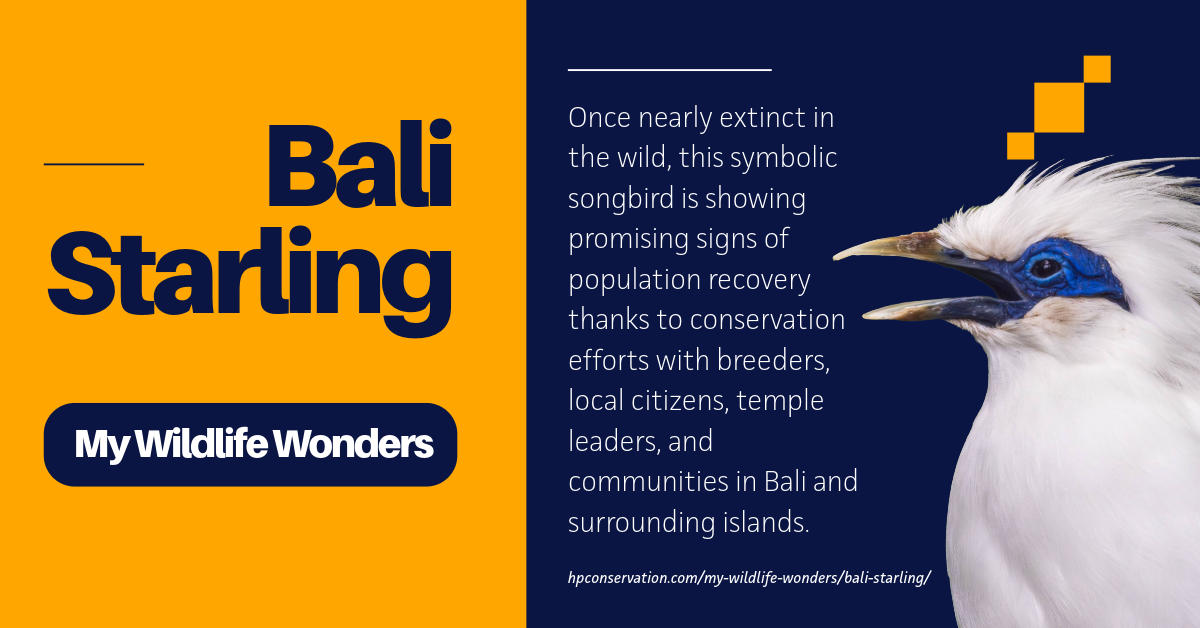
A hush falls over the misty forest of Nusa Penida. Light rain weaves silver threads through the canopy. From the hush of the foliage, a flash of white breaks the green—a bird glides in, landing with effortless precision on a spiny trunk. It’s a striking bird with brilliant white feathers, a deep blue leathery patch around its dark eyes, and black-tipped wings and tail.
Moments later, its companion arrives. They perch facing in opposing directions, luminous against the dark bark and dripping leaves. One raises its crest and sings. The other turns inward, preening damp feathers with a rhythmic calm. These are Bali starlings, among the rarest birds on earth.
Species: Bali Starling
Also Known As: Bali myna, jalak Bali, Rothschild’s mynah

The Bali starling was first described to science in 1912, but fewer than 10 individuals were believed to survive in the wild by 2001, following catastrophic losses from habitat destruction and illegal poaching for the songbird trade. Now, the critically endangered bird is making a comeback from the brink of extinction in the wild, thanks to a combination of conservation approaches. The last 30 years of conservation has included establishing protected lands, market-based approaches, and partnerships with Indigenous communities in Bali and Nusa Penida that established permanent refuges for reintroduction. As a result, the rare and symbolic birds have become critical sources of eco-tourism dollars for many villages.
The Bali starling’s tale is one of incredible recovery. Today, through collective community efforts focused on safeguarding and conserving the species in its natural habitat, the Bali starling is being restored from a captive possession to a creature stewarded by local communities. These communities act as protectors of the bird’s unique cultural and spiritual value, enabling its revival in the wild. As of the most recent population survey in October 2021, there were approximately 420 wild Bali starlings living in Bali Barat National Park, according to standardized counts conducted by park staff, and another approximate 100 individuals are estimated to live on Nusa Penida.
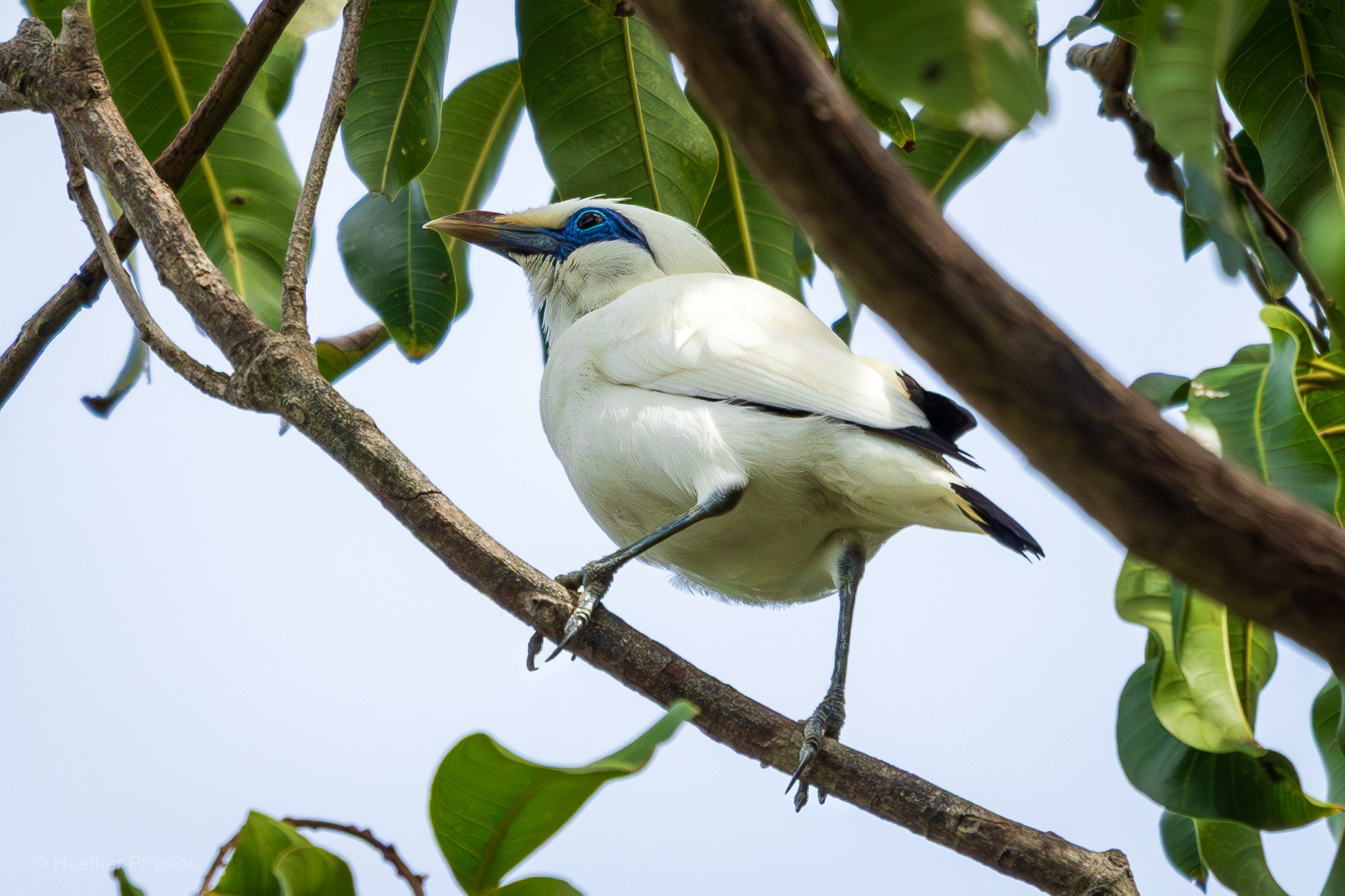
Bali Starling Range & Habitat
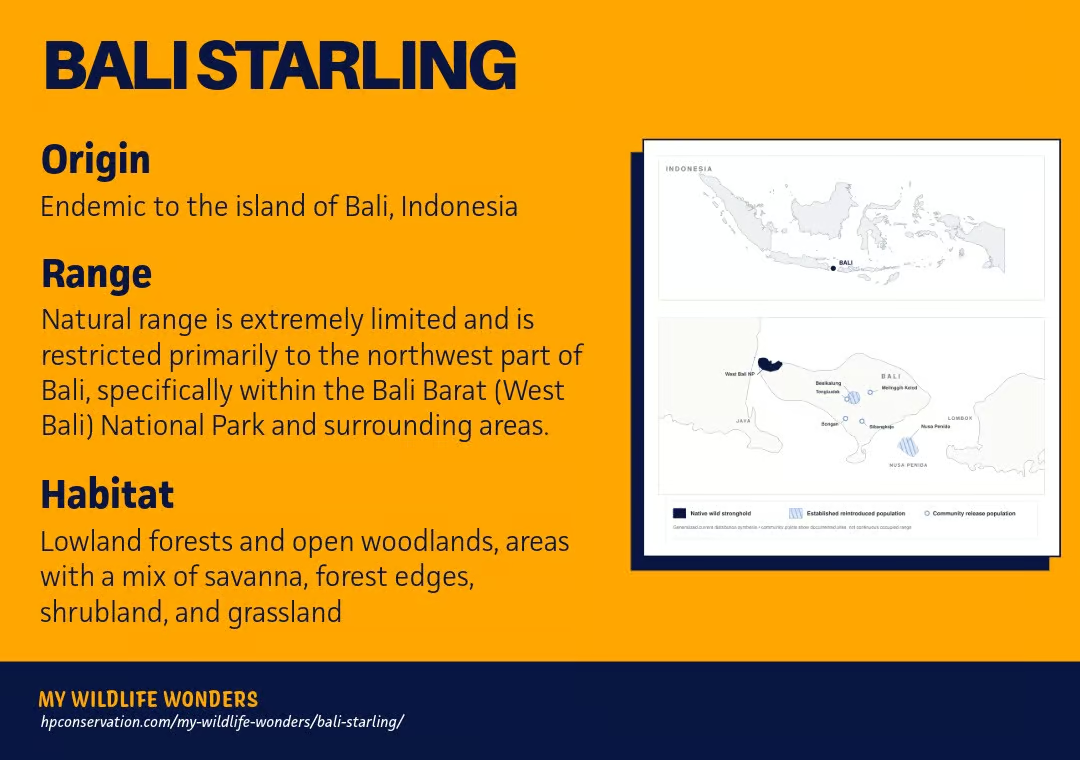
- Origin: Endemic to the island of Bali, Indonesia. The Bali starling is the only endemic vertebrate on the island, making it uniquely important to local biodiversity. Balinese culture also reveres the bird’s white plumage as a symbol of purity and a link between the divine and earthly worlds.
- Range: Natural range is extremely limited and restricted primarily to the northwest part of Bali, specifically within the Bali Barat (West Bali) National Park and surrounding areas. Ex-situ conservation populations are being established on Nusa Penida island.
- Habitat: Lowland forests and open woodlands, areas with a mix of savanna, forest edges, shrubland, and grassland
Quick Facts About the Bali Starling
- Order: Passeriformes (perching berds)
- Family: Strunidaae (starlings)
- Genus: Leucopsar
- Species: Leucopsar rothschildi
- Diet: Fruit, seeds, insects, earthworms, nectar, small reptiles
- Height: 9 to 10 inches
- Weight: 2 to 4 ounces
- Lifespan: 5 to 8 years in the wild
- Sexual Maturity: 1 year
- Natural Predators: Snakes, eagles, hawks, lizards
Bali Starling Mating
- Mating System: Monogamous long-term pair bonds
- Mating Season: Bali’s rainy season, November through April
- Courtship Displays: Males raise crest feathers, perform loud calls and bob. Pairs mutually groom feathers.
Bali Starling Reproduction
- Nesting Habits: In tree cavities, often holes excavated by woodpeckers, about 4 to 10 meters off the ground. They line old woodpecker holes or artificial nests with twigs, grass, and leaves
- Broods: 2 to 4 pale blue eggs per clutch, up to 3 broods per season
- Incubation: 12- to 15-day incubation period
- Offspring: Often 1 chick survives per brood

Bali Starling Conservation Status
Critically Endangered
(Last assessed by IUCN 2021)
- Key Threats: The primary threats to the Bali starling’s survival include habitat destruction and poaching for the illegal songbird trade. Poaching drove the Bali starling to near extinction by the mid-1990s, with fewer than 10 individuals left in the wild. Today, an estimated 2 to 4 times more exist in captivity than in the wild.
- Conservation Efforts: Once nearly extinct in the wild, this symbolic songbird is showing promising signs of recovery thanks to a combination of conservation efforts with breeders, local citizens, temple leaders, and communities in Bali and surrounding islands. Conservation efforts focus on protecting and restoring its habitat within Bali, as the species does not naturally disperse to other regions.
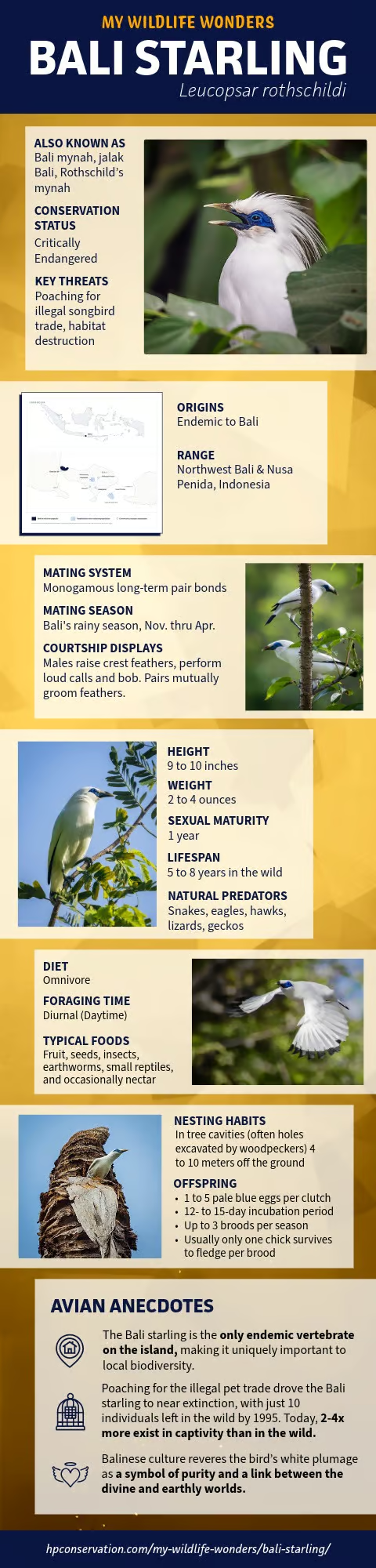
Wildlife Snapshot Infographic: Bali Starling
The story of the Bali starling is rich with cultural and ecological nuance. See this infographic guide to the Bali starling for a quick digest of the species’ key traits, conservation status, and importance to Balinese culture.
Bali Starling Coloring Book Page & Learning Activity Sheets for Kids
Click below to download free, fun Bali starling activities and coloring sheets for kids to enjoy and learn more about endangered species like the Bali starling!
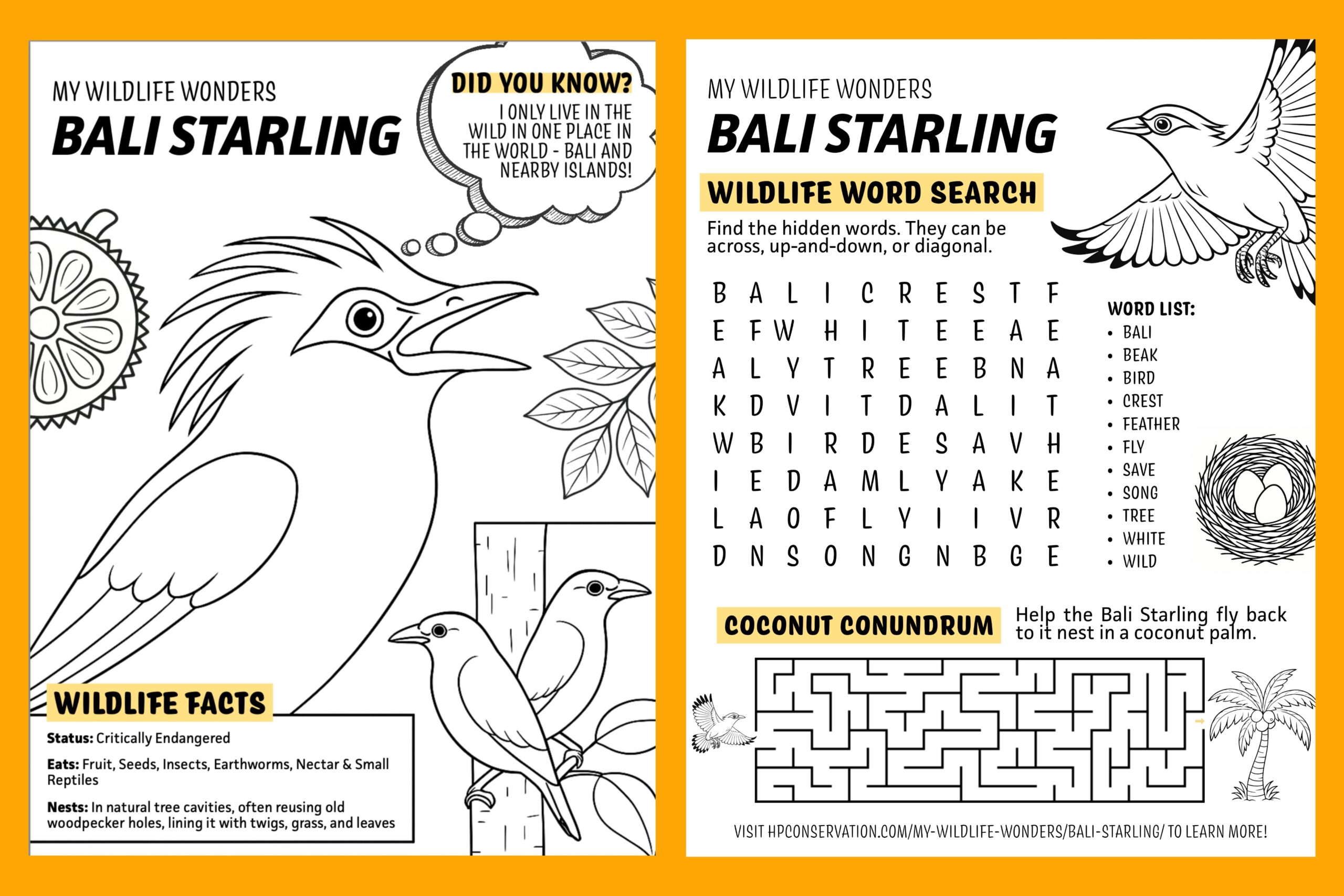
Printing tip: These pages are designed for 8.5″ x 11″ (Letter) size paper, standard in U.S. printers. Select “Fit to page” (or similar) in your printer dialog menu to ensure all the contents are printed. Choose “Point on Both Sides” or “Print 2-Sided” to reduce paper waste.
Sources
- Buana, A.P., and M.A.W. Mamonto. (2023). “The Role of Customary Law in Natural Resource Management: A Comparative Study Between Indonesia and Australia.” Golden Ratio of Mapping Idea and Literature Format Vol 3 No 2: 167-186.
- Hernowo, J.B., and S. Haquesta. (2021). “Evaluation on Bali Mynah (Leucopsar rothschildi Stresemann, 1912) Population, Result of Release Process 1998-2015 in Bali Barat National Park, Indonesia.” Biodiversitas Vol 22 No 7: 2699-2710.
- Jani and Zuhra. (2024). Interview by Heather Physioc. Nusa Penida, Indonesia. Dec. 3, 2024.
- Jayantiari, I.G.A.M.R., I.G.P.B.S. Arjawa, L. Rebeiro and J.A. Paquita. (2024). “Forming Legal Culture in Customary Forest Management: Local Wisdom Approach of Customary Law Communities.” Udayana Journal of Law and Culture Vol 8 No 1: 67-82.
- Jepson, Paul. (2025). Interview by Heather Physioc. May 25, 2025.
- Jepson, P.R. (2016). “Saving a Species Threatened by Trade: A Network Study of Bali Starling Leucopsar Rothschildi Conservation.” Oryx Vol 50 No 3: 480–488.
- Jepson, P., and R.J. Ladle. (2008). “Governing Bird-keeping in Java and Bali: Evidence From a Household Survey.” Oryx Vol 43 No 3: 364–374.
- Jepson, P., R.J. Ladle and Sujatnika. (2011). “Assessing Market-based Conservation Governance Approaches: A Socio-Economic Profile of Indonesian Markets For Wild Birds.” Oryx Vol 45 No 4: 482–491.
- Miller, R., E. Garcia-Pelegrin and E. Danby. (2022). “Neophobia and innovation in Critically Endangered Bali myna, Leucopsar rothschildi.” R. Soc. Open Sci. Vol 9: 211781.
- Pramatana, F., J.B. Hernowo and L.B. Prasetyo. (2021). “Effects of Human Factors in the Existence of Bali Starling (Leucopsar Rothschildi) Through Geographic Infomation System Approach in West Bali National Park and Nusa Penida Bali.” Media Konservasi Vol 26 No 2: 118-127.
- Pramatana, F., J.B. Hernowo and L.B. Prasetyo. (2022). “Population and Habitat Suitability Index Model of Bali Starling (Leucopsar rothschildi) in West Bali National Park.” Jurnal Sylva Lestari Vol 10 No 1: 26-38.
- Riley, E.P. (2010). “The importance of human–macaque folklore for conservation in Lore Lindu National Park, Sulawesi, Indonesia.” Oryx Vol 44 No 2: 235–240.
- Saroyo et al. (2024). “Pertumbuhan Distribusi, Ukuran Kelompok, dan Aktivitas Kerak Kerbau (Acridotheres javanicus Cabanis, 1851) dan Kerak Perut-Pucat (Acridotheres cinereus Bonaparte, 1850) di Kota Manado dan Kabupaten Minahasa Utara, Sulawesi Utara.” Jurnal Bios Logos Vol 14 No 1: 86-96.
- Squires, T.M., N.J. Collar, A. Nurcahyo, N.L.K.K. Ardana, L.P.E. Yuni, A. Owen, S.S. Nugroho, N.L. Watiniasih and S.J. Marsden. (2024). “The road to recovery: conservation management for the critically endangered Bali myna Leucopsar rothschildi shows signs of success.” Oryx Vol 58 No 1: 125-134.
- Sudaryanto, F.X., S. Pudyatmoko, J. Subagja and T.S. Djohan. (2019). “Peranan Awig-awig Desa Adat Dalam Konservasi Jalak Bali Di Kepulauan Nusa Penida.” Jurnal Kajian Bali Vol 09 No 01: 227-240.
- Sudaryanto, F.X., S. Pudyatmoko, T.S. Djohan, J. Subagja, I.W. Suana, L.A.T.T.W.S. Kalih, J. Hardini and J. Subagio. (2020). “Daily activity, diet and habitat of Bali myna (Leucopsar rothschildi) in Nusa Penida, Bali, Indonesia.” Biodiversitas Vol 21 No 10: 4474-4482.
- Sutomo, and E. van Etten. (2021). “Natural Habitat of Bali starling (Leucopsar rothschildi) in Bali Barat National Park, Indonesia.” Biotropia Vol 28 No 2: 117-127.
- Uyeda, L.T., A. Wirsing, E. Iskandar, A. Purbatrapsila and J. Pamungkas. (2015). “The Role of Traditional Beliefs In Conservation Of Herpetofauna In a Managed Forest On Tinjil Island, Indonesia.” Oryx Vol 49 No 2: 363–366.
- Wirayudha, Dr. Bayu. (2025). Interview by Heather Physioc. May 12, 2025.
- Wulandari, I.I., W. Prihatini and C. Sudrajat. (2024). “Laju Pertumbuhan Anak Jalak Bali (Leucopsar Rothschildi) Dengan Pemberian Sumber Protein Berbeda Di Penangkaran.” JURNAL BIOLOGI UDAYANA Vol 28 No 1: 29-37.


