
MADISON, Wisconsin — For over 50 years, the Endangered Species Act (ESA) has been the nation’s most effective defense against extinction, preventing the loss of 99 percent of listed species. Without these federal safeguards, iconic American wildlife, including the bald eagle, grizzly bear, humpback whale, and peregrine falcon might exist only in memory.
Yet, the ESA has increasingly been a political target, framed by industry lobbies as an obstacle to economic growth. Mining trade associations have labeled the Act a “permitting bottleneck” for projects like Nevada’s Rhyolite Ridge lithium mine, where protection for a rare wildflower has delayed mineral extraction. Energy and ranching lobbies have similarly argued that protections for the lesser prairie chicken–whose habitat sits atop the nation’s most productive oil fields–constitute “red tape” that threatens domestic energy security. In both cases, lobbies are pushing to circumvent biological jeopardy assessments to accelerate permitting and prioritize industrial output.
“The evidence suggests that those arguments are at best misinformed, at worst disingenuous, attempts to use devolution of authority to the states as deregulation,” Alejandro Camacho, Professor of Law at UCLA, where he specializes in environmental law, natural resources, and land use regulation, said.
In response to continued industry pressure, Republican lawmakers have waged a years-long campaign to push key decisions away from scientists–replacing biological thresholds with economic calculations, narrowing what counts as harm to species, and creating administrative loopholes that allow development to bypass provisions in the statute.
The most recent example of this pressure is reflected in the recently shelved ESA Amendments Act of 2025 (H.R. 1897), sponsored by Arkansas Republican Bruce Westerman. If his bill had passed, it would have allowed states to bypass rigorous federal science, expanded administrative loopholes for killing protected species without appropriate environmental review, and explicitly banned citizen lawsuits against premature delistings for five years.
“What is the economics of saving a species–pricing the priceless?” Kristen Boyles, managing attorney of nonprofit environmental law firm Earthjustice, asked. “The equation only ever goes one way; it never talks about the costs of not protecting. It puts a gloss on things through a lens of resource use and resource depletion, as opposed to a protection measure.”
The question is especially poignant as America marks its 20th Endangered Species Day. Established by Congress in 2006 to educate the public and reflect on the ESA, the holiday, set for the third Friday of every May, now highlights the fractured system of state laws that awaits if federal safeguards fall. As Camacho notes, pushing responsibility to the states often means handing power to entities that “don’t have the law, don’t have the resources, and in some states, don’t have the inclination.”
“The state laws that are currently in place don’t go anywhere near as far, they’re not nearly as robust as the federal Endangered Species Act is,” Camacho, who co-authored a comprehensive 50-state assessment of endangered species protections, said. The report found an uneven patchwork of state protections, including severely limited funding, inconsistent scientific standards, fewer species listed and weaker habitat protections. While some states have strengthened protections since, many of the same gaps remain.
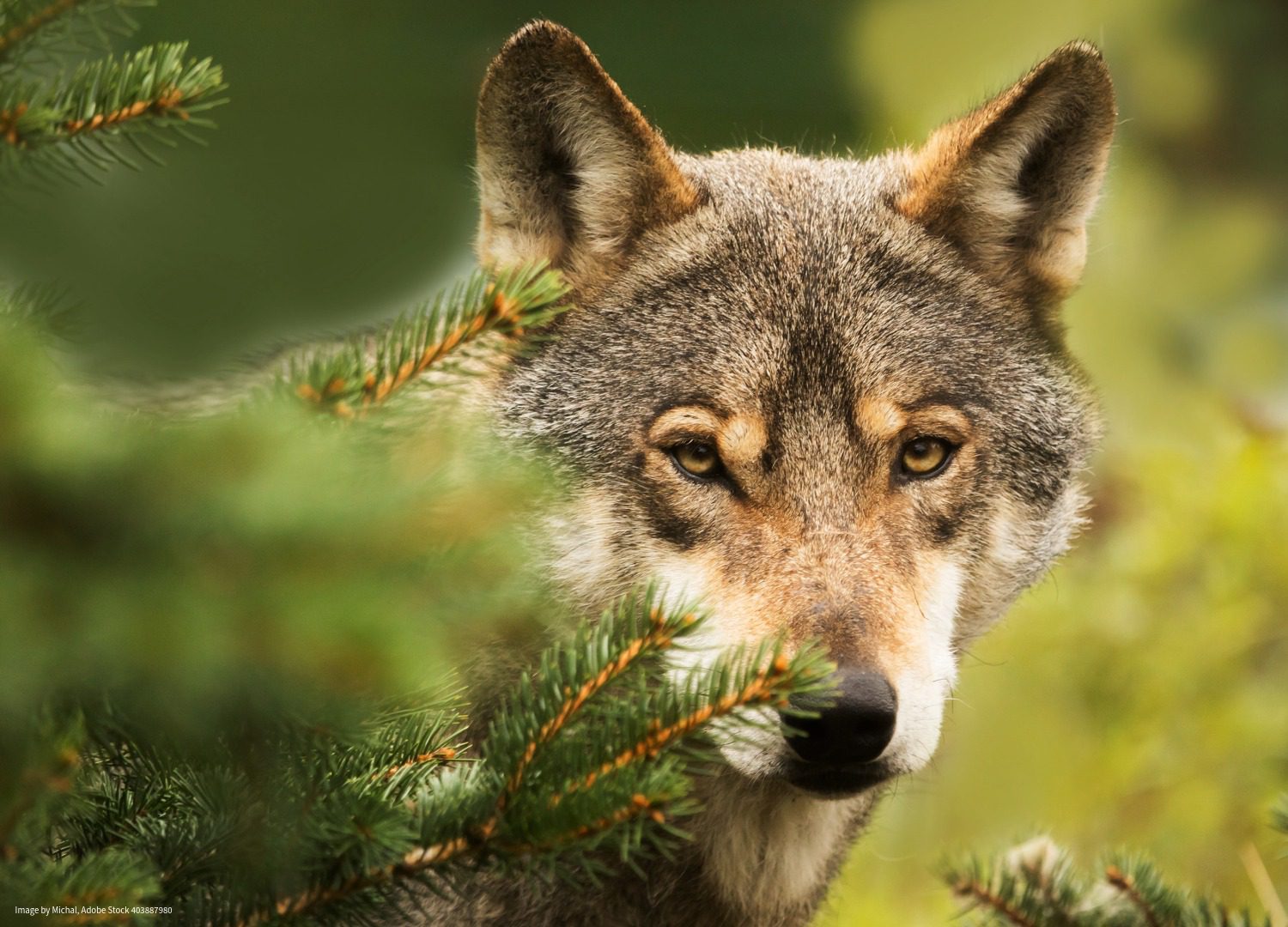
Gray wolves illuminate the limitations of state protections when federal listing is under threat.
Perhaps no other species demonstrates these stakes of losing federal protections more visibly than endangered large predators, especially wolves.
Decades of ecological research indicate that wolves are apex predators that trigger vital trophic cascades, structurally engineering their ecosystems. Without them, numerous studies have concluded, unchecked herbivores overgraze and decimate forest regeneration and plant biodiversity. Wildlife biologists warn that the loss of wolves risks destabilizing the broader food web by allowing mid-sized predators, such as coyotes, to surge, thus depriving scavengers of crucial carcass remains, and removing a natural barrier against the spread of deadly wildlife illnesses, including Chronic Wasting Disease in deer populations.
Without federal ESA protections, states set their own thresholds–and for wolves, that has meant managing the species toward the bare minimum required for survival.
In Wyoming, Montana, and Idaho, where the Northern Rockies population of gray wolves were delisted from the ESA through a rare act of Congress in 2011 that bypassed the usual scientific process, the result has been aggressive state management. Since delisting, all three states have implemented aggressive hunting and trapping seasons to reduce wolf numbers. In some cases, hunters are allowed to use an arsenal of methods once prohibited under federal law, such as night hunting with thermal optics, bounties, and expanded bag limits. Across 85 percent of Wyoming, wolves are classified as “predatory animals,” allowing them to be killed on sight, without limits, year-round.
A coalition of more than 70 conservation groups has formally argued that these current high harvest rates disproportionately target dispersing wolves, risking genetic isolation and preventing the safe migration that is necessary for their long-term survival.
However, while the Northern Rockies show the effects of aggressive state management, wolf advocates contend that another state reveals the dangers of legislative inflexibility and illustrates why the ESA is the ultimate–and sometimes only–safety net for the maligned apex predator. In Wisconsin, tensions between science, law, and politics offer a different, but equally consequential, outcome for wolves.
State law and the ESA are uniquely entangled. A 2012 statute, Act 169, mandates that the state open a wolf hunting and trapping season whenever federal protections are removed. This legislative hair-trigger means that the moment federal ESA protections drop, state management takes over on autopilot.
“Wisconsin is the only state of the three Great Lakes states that has a law that requires the state to hold a wolf hunting season if they’re delisted,” Adrian Wydeven, biologist at conservation group Wisconsin’s Green Fire, said.
When gray wolves were briefly delisted in January 2021, this law was immediately activated by a trophy hunting advocacy group’s lawsuit, triggering a mandatory hunt. The sudden loss of federal oversight stripped state biologists of the flexibility to decide if a hunt was biologically appropriate or set the season. The law mandates a hunt from the first Saturday in November to the last day of February, during the wolves’ late-winter breeding season when their need to defend territory is at its peak.
“If the wolves come off the list, managers in Wisconsin don’t have the discretion to reduce the length of the season,” retired 30-year conservation biologist Timothy Van Deelen said. “They could do that for deer or turkeys, but they can’t do it for wolves. It makes it inflexible, rigid.”
The law also authorizes the use of controversial hunting methods, such as the use of foothold traps and cable restraints, bait, and tracking dogs. The hunt lasted less than three days, and hunters killed 218 wolves, exceeding the state quota by 83 percent before managers could shut it down.
For the Ojibwe tribes, whose creation stories tie their fate to Ma’iingan (the wolf), the 2021 hunt was both a cultural and legal affront. Under the 1800s treaties that established a 50-50 co-management structure for the region’s resources, the tribes legally claimed their quota of 81 wolves and made the sovereign decision to declare a “zero harvest” to keep them alive. The state’s rapid overharvest violated this treaty and circumvented tribal custom by obliterating the Ojibwe’s conservation effort.
“Zero harvest is a tool that the tribes are in their rights to utilize,” Dylan Bizhikins Jennings of the Great Lakes Indian Fish & Wildlife Commission (GLIFWC) said. “To take those tribal quotas does not speak to a responsible co-manager or co-collaborator. It’s a blatant disrespect to tribal communities and their environmental and scientific knowledge.”
The subsequent planned November wolf hunt in Wisconsin was prevented by a state court order, triggered by a lawsuit from conservation groups, which ruled that the Wisconsin Department of Natural Resources violated state law by operating under outdated rules and failing to properly consult its wolf advisory committee. Shortly after, a federal judge restored the wolf’s ESA protection, returning the population to federal safeguarding.
State conservation efforts are limited and inconsistent compared to the federal ESA.
Wisconsin illustrates one example of what’s at risk when ESA guardrails fall away, shifting decisions away from science-based thresholds: protections can be lifted before populations are biologically secure, exposing species to increased killing, habitat loss, and development pressures. Experts say this can undermine a species’ long-term recovery, with grave consequences on the ground.
“If you remove the funding, you remove the protections, the ecosystems will degrade and ultimately collapse,” Camacho said.
The ESA is designed to prevent this kind of outcome by mandating that decisions about a species’ survival be made “solely on the basis of the best scientific and commercial data available.” Boyles calls this requirement “one of the strongest points” of the law, ensuring agencies “make these decisions using the best science that’s out there.”
Even without sweeping reforms like H.R. 1897, challenges to the Endangered Species Act continue to test how much of the law’s science-backed foundations can be chipped away without formally dismantling it.


