
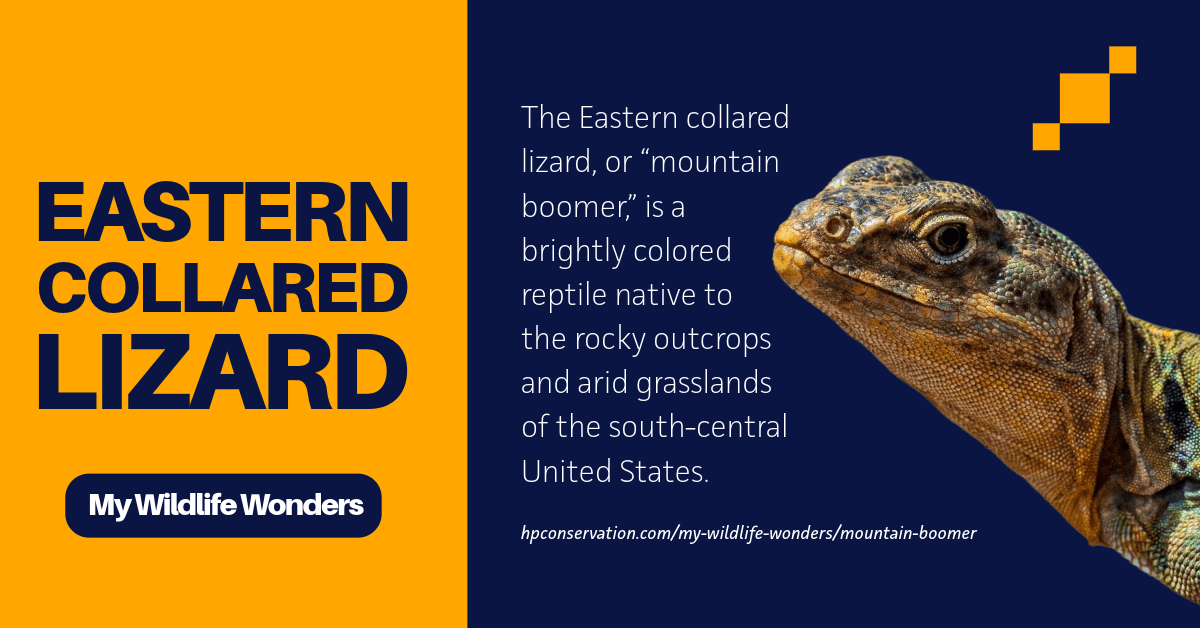
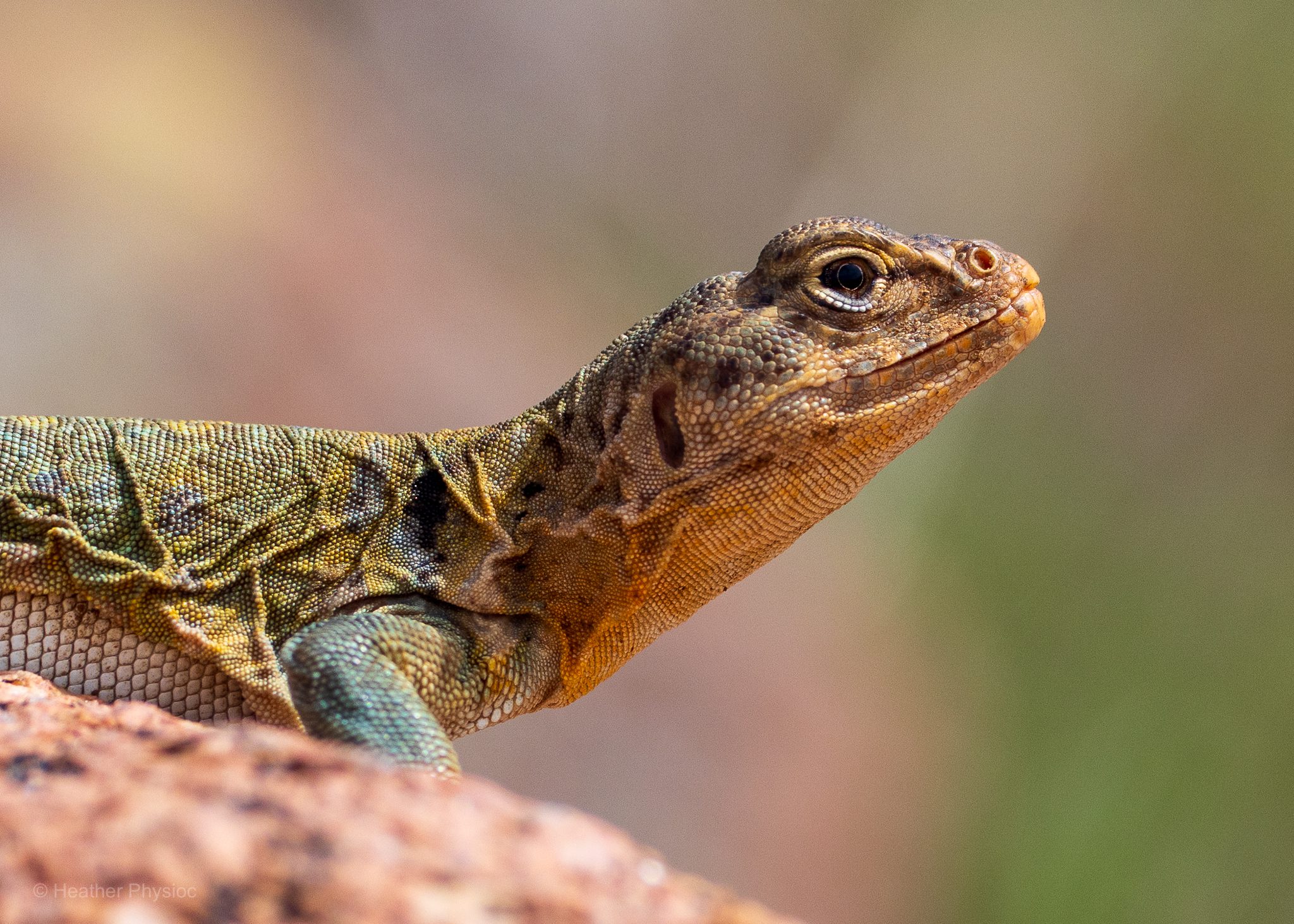
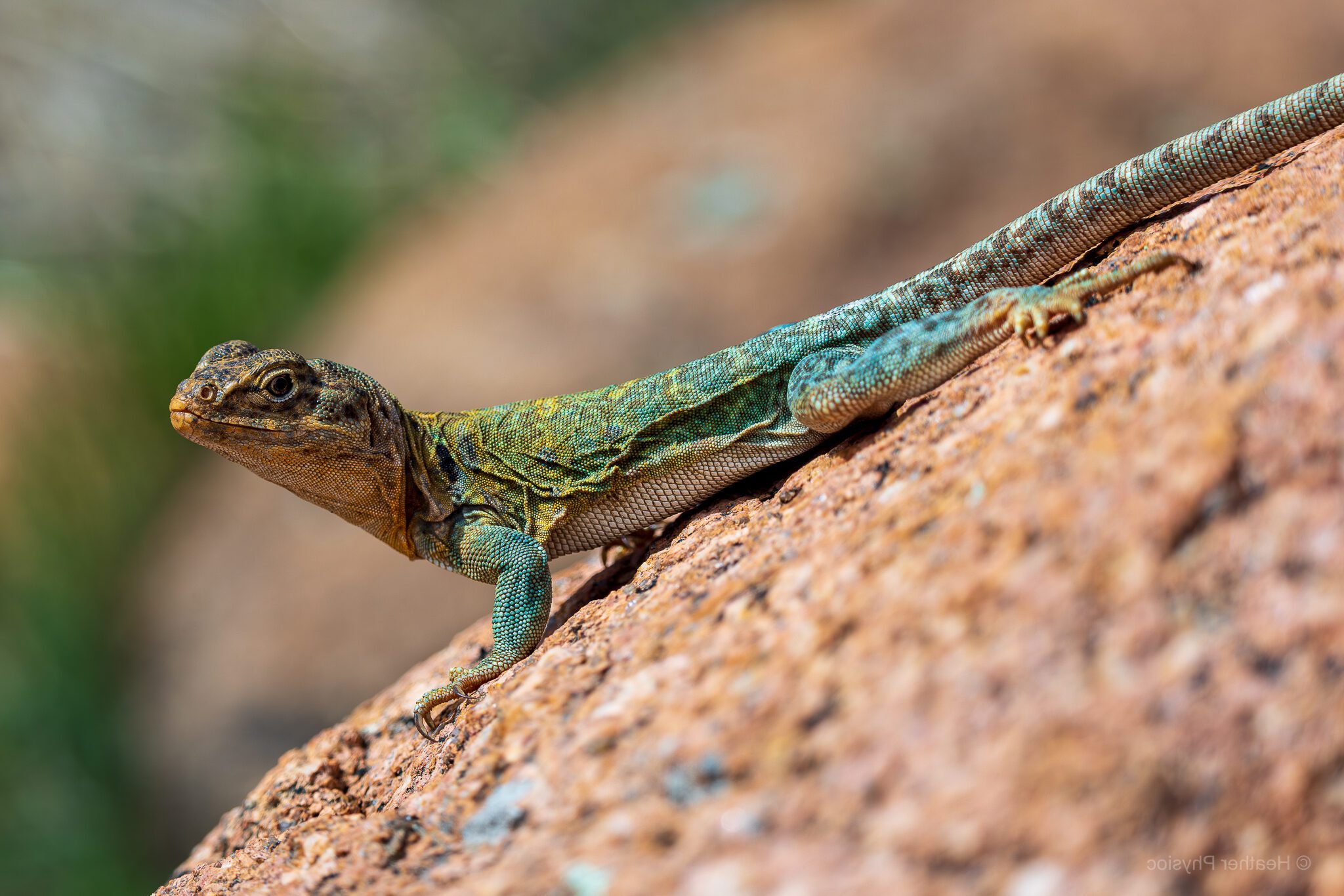
The eastern collared lizard, colloquially called the “mountain boomer,” is named for its distinctive black “collar” markings around the neck and shoulders. Males are particularly colorful, displaying blue-green bodies, yellow stripes, and orange or yellow throats, while females have more subdued coloration.
They can run on their hind legs, reaching speeds of up to 15 miles per hour to escape predators or chase prey, like insects and even other lizards. They are agile as they leap and maneuver among the granite and sandstone, their long tails acting as a counterbalance.
Species: Eastern Collared Lizard
Also Known As: Common collared lizard, Mountain Boomer
These lizards live in rocky, open habitats with sparse vegetation, like granite boulder fields, canyons and slopes. Hiking through the Wichita Mountains of Oklahoma, where this species is the state reptile since 1969, I frequently spotted them darting between boulders. They are highly alert in the daytime, often basking in the sun but quick to retreat into crevices when threatened.
Once widespread across rocky glades in the central U.S., populations plummeted in the 20th century as fire suppression allowed trees and brush to choke out the open habitats these lizards need. By the 1980s, they had vanished from as much as 75 percent of their former range in the Ozarks.
The turning point came when scientists recognized that prescribed fire wasn’t a threat, but a lifeline. In places like the Wichita Mountains Wildlife Refuge and the Missouri Ozarks, managers reintroduced fire, cleared invasive red cedars, and in some cases even translocated lizards to repopulate restored glades. The results were striking: habitats reopened, genetic diversity rebounded, and once-isolated lizards could disperse between rocky outcrops again.
Today, the eastern collared lizard is stable enough to earn “Least Concern” status on the IUCN Red List, but only where fire regimes are actively managed. In refuges and restored glades, they thrive. In neglected, overgrown habitats, they hang on in smaller, more vulnerable pockets.
Collared Lizard Range & Habitat
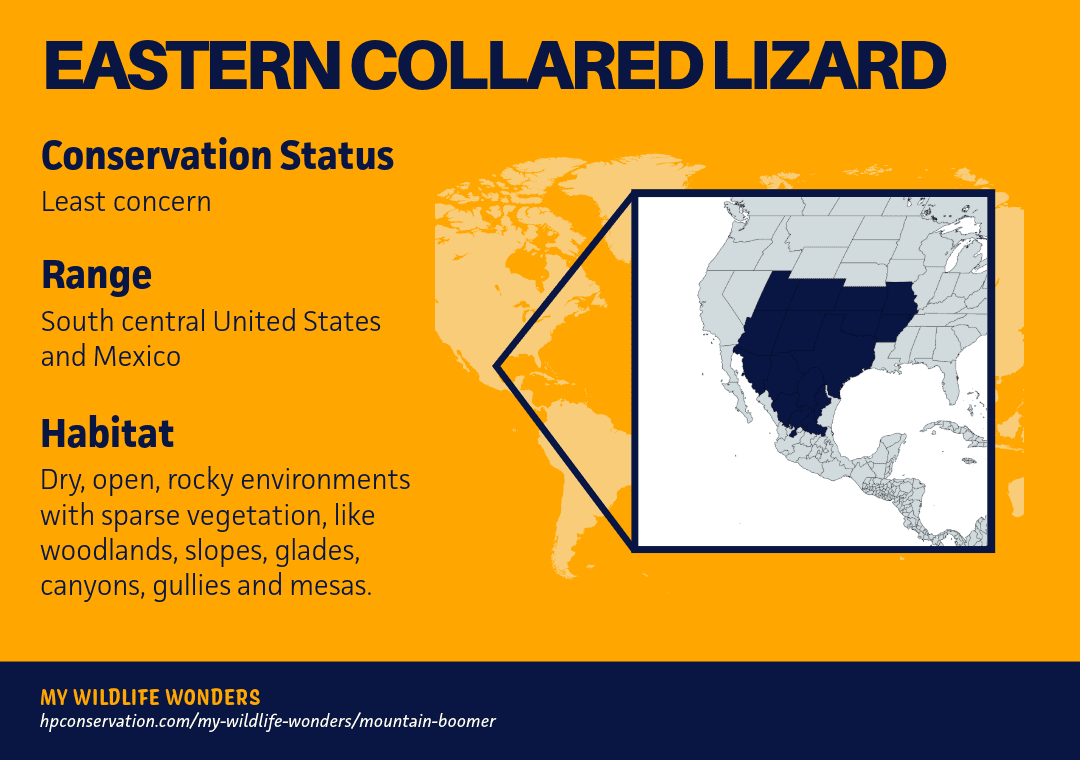
- Origin: Native to the central and southwestern United States and northern Mexico.
- Range: Spans from southeastern Utah and Arizona across Texas, Oklahoma, Kansas, Missouri, Arkansas, and into northern Mexico, with isolated populations in Colorado, Nebraska, Illinois, and nearby states.
- Habitat: Dry, open environments featuring abundant rocks, like open woodlands, rocky slopes, glades, canyons, gullies and mesas. Typically occupies areas with sparse vegetation and frequently uses large rocks or lookout perches to survey for predators and prey.
Quick Facts About the Eastern Collared Lizard
- Order: Squamata (scaled reptiles)
- Family: Crotaphytidae (collared and leopard lizards)
- Genus: Crotaphytus
- Species: Crotaphytus collaris
- Diet: Insects (grasshoppers, beetles, and moths), spiders, small snakes and other lizards
- Height: 8 to 14 inches (including tail)
- Weight: 2 to 3 ounces in adulthood
- Lifespan: 4 to 5 years in the wild
- Sexual Maturity: 1 to 2 years
- Natural Predators: Snakes, birds of prey (hawks, eagles), larger mammals, other predatory reptiles
Collared Lizard Mating
- Mating System: Polygynous; one male mates with multiple females and actively defends a territory that may overlap with several female home ranges.
- Mating Season: Spring and summer months, timing depends on location and local environmental conditions.
- Courtship Displays: Males perform striking visual displays such as head-bobbing, push-ups, and extension of their brightly colored throat (dewlap) to attract females and signal dominance. Territorial males may also use aggressive posturing and physical displays against rival males. During close courtship, males may nuzzle or bite the female’s neck or tail; females often develop distinct orange reproductive coloration that stimulates male courtship.
Collared Lizard Reproduction
- Nesting Habits: Females lay eggs in burrows or crevices, often digging beneath large rocks or using rodent burrows to deposit them. They then cover the eggs with soil to protect them.
- Broods: One to two clutches per year, with each clutch containing 4 to 24 eggs depending on the size and age of the female, laid about 20 days after breeding. (Four to 11 eggs is typical.)
- Incubation: Eggs incubate for 55 to 65 days, depending on temperature and environmental conditions. Sex of the hatchlings is influenced by incubation temperature.
- Offspring: Hatchlings emerge fully developed and independent, showing no parental care. Juveniles grow rapidly and may be capable of reproduction within their first or second year.
Collared Lizard Conservation Status
Least Concern (Last assessed by IUCN 2007) with stable overall populations, some local declines
- Key Threats: Habitat loss and degradation caused by fire suppression, urban development and encroachment of woody vegetation like cedars that replace its preferred open glade and rocky habitats. Habitat fragmentation and population isolation have also contributed to local declines. Additionally, collection for the pet trade poses some risk, though less severe than habitat loss.
- Conservation Efforts: Restoring and maintaining open, fire-tolerant habitats using prescribed burns and removal of invasive woody plants. Multi-agency partnerships between wildlife departments, zoos and conservation organizations have implemented captive breeding and reintroduction programs to bolster populations in historically occupied areas. Ongoing monitoring and research to better understand population dynamics and threats to ensure long-term survival, particularly in Arkansas and other states where the species has declined.
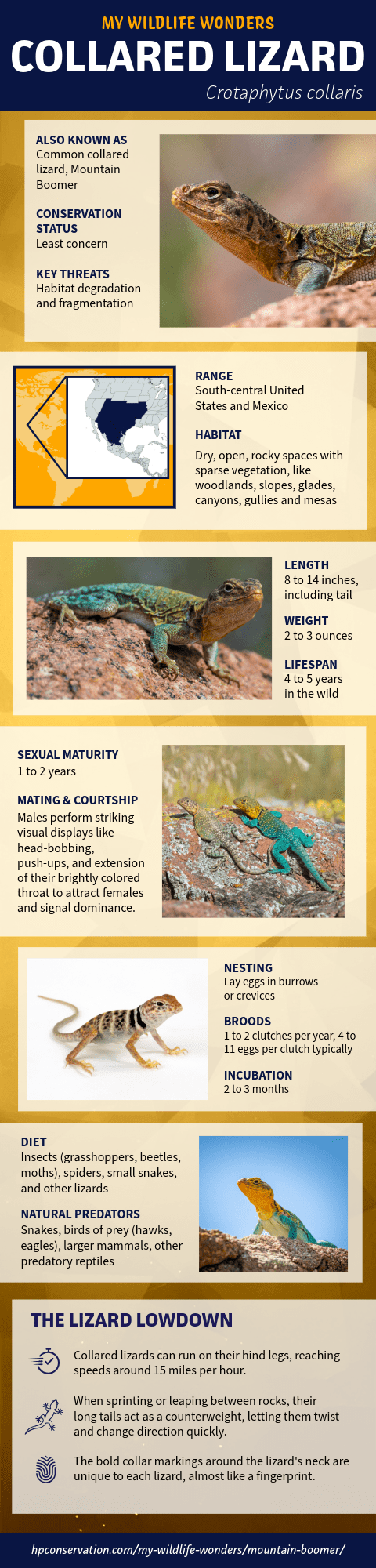
Wildlife Snapshot Infographic: Collared Lizard
The story of the eastern collared lizard is rich with cultural and ecological nuance. This infographic guide to the eastern collared lizard provides a quick digest of the species’ key traits, conservation status, and importance to the American Midwest.
Collared Lizard Coloring Book Page & Learning Activity Sheets for Kids
Click below to download free, fun collared lizard activities and coloring sheets for kids to enjoy and learn more about reptiles, such as the eastern collared lizard.
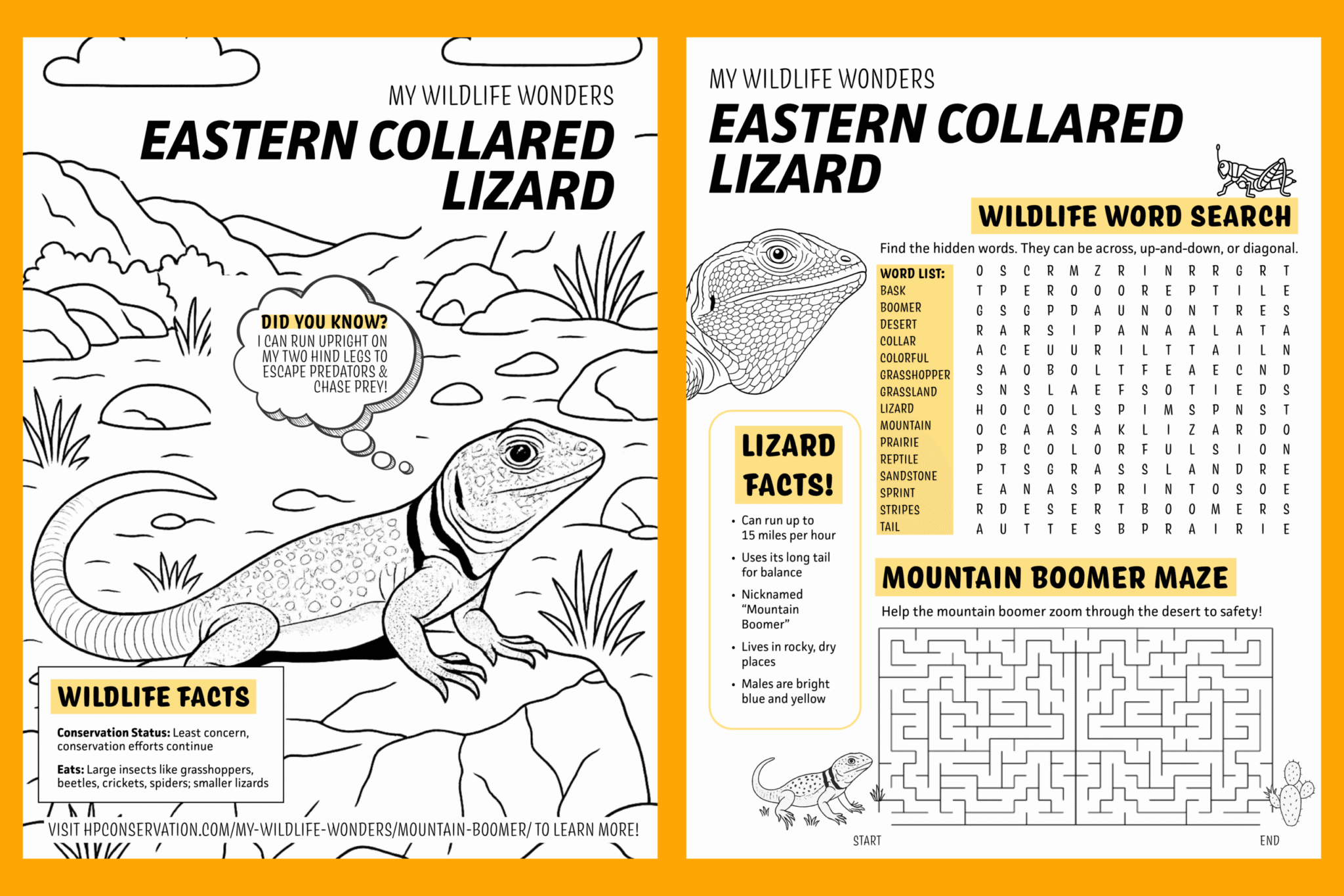
Printing tip: These pages are designed for 8.5″ x 11″ (Letter) size paper, standard in U.S. printers. Select “Fit to page” (or similar) in your printer dialog menu to ensure all the contents are printed. Choose “Point on Both Sides” or “Print 2-Sided” to reduce paper waste.
Sources (Alphabetical)
- Animal Conservation
- Animal Diversity Web
- Arkansas Game & Fish Commission
- LandPKS
- Little Rock Zoo
- Missouri Department of Conservation
- Mol Ecol
- National Park Service
- NatureServe Explorer
- Oklahoma Department of Wildlife Conservation
- Southern Illinois University Dept. of Ecology
- University of Arkansas
- Utah Division of Wildlife Resources