
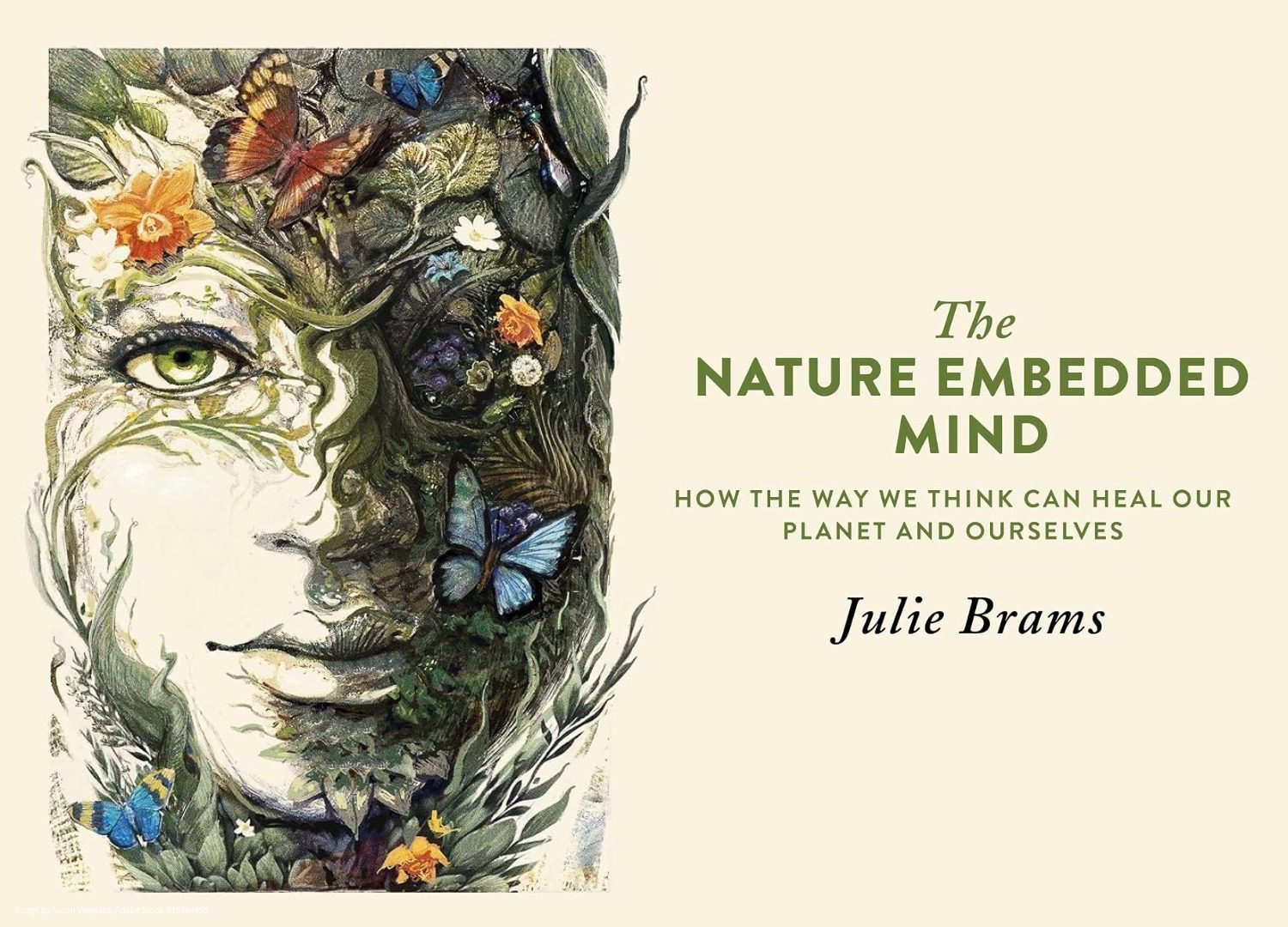
If you are interested in mental health, forest bathing and nature therapy, this book may be for you. The Nature Embedded Mind: How The Way We Think Can Heal Our Planet and Ourselves, by Julie Brams, calls into question the problematic idea of human dominance over nature, and offers a guide to personal and planetary healing by reclaiming our innate, interconnected relationship with the Earth.
Brams posits that humanity has a broken relationship with nature, believing ourselves to be somehow separate from nature rather than part of it. Thus, we make choices that go against our own wellbeing, destroying the very nature we and all life depend on. Brams challenges readers to “reEarth” and shift our perception to see ourselves as part of the whole, and evaluate the “nature-disconnected language” we use that creates false separation between ourselves and the planet.
About the Book
In The Nature Embedded Mind: How the Way We Think Can Heal Our Planet and Ourselves (2025), psychotherapist Julie Brams argues that humanity’s persistent illusion of being separate from and superior to nature is the root cause of both ecological destruction and psychological suffering – and offers an alternate path to personal and planetary healing by reconnecting with the Earth.
Buy the Book
The author also asserts guided forest bathing as one means for reestablishing a healthy relationship with and within nature, where participants engage in healing activities and sensory experiences of the natural environment. More than just being mindful in nature, forest therapy encourages more of a “dialogue” with nature.
“[A] director of Japan’s Forest Agency, coined the term Shinrin Yoku (Forest Bathing) to encourage people to bathe in the atmosphere of the forests both to improve their own health and to create a desire to protect the country’s ancient forest land,” Brams writes. “Japan is home to amazing old-growth forests with many trees over 1,000 years old. It was Akiyama’s intent to make sure Japan maintained a natural desire to protect them.”
Though accessible to the mental health curious reader, The Nature Embedded Mind is written from a therapist and guide’s perspective, and aimed at fellow mental health practitioners with interest in expanding modalities to include new nature therapy techniques as a complement to traditional Western psychology practice. There is much evidence of the benefits of forest bathing for mental health, but the book leans heavily into the tools of the Association of Nature & Forest Therapy (ANFT) guide certification program, and its scope is limited to a single methodology.
However, as a person who constantly wrestles with a desire to control and orchestrate, the emphasis on guides allowing participants to have their own experiences without steering them is a relevant consideration for many aspects of life. “When we let go of trying to manipulate a desired experience or outcome, then we can truly support healing,” Brams writes in The Nature Embedded Mind. “[The guides] must learn to abandon their own hopes so that they can create space for the reality of authentic experiences.”
Throughout the book, Brams offers reflection questions for readers to engage in the process themselves. The invitations to reflect explore sensory awareness, empathy and connection, and relational shifting from “What can I get?” to “What can I give?” The questions invite participants to pause and observe their internal and external environments, exploring their personal relationships with nature and questioning pre-existing beliefs about their relationship with the rest of nature.
The most relatable part of the book is the series of Brams’s personal reflections from her own ANFT certification experience, where she journaled each morning and night and noted the transformation. In one journal entry she noted one observation that stuck with me: “Remembering to stay with my truth — to ward off thinking I should be like anyone else. Watching how fear operates. Remembering that fear complicates things unnecessarily.”
Letting go of fear is precisely what allows participants to transition from isolated internal processing to communal integration. This is realized at the end of each day’s outdoor explorations, when participants come back together to share tea and their experiences. It’s a fitting representation of the individual vulnerability and collective connections that Brams suggests lead to both personal and social wellness in nature. By gathering in this ancient, communal way, Brams suggests we are actually reclaiming a piece of our wildness.
Ultimately, The Nature Embedded Mind leaves us with a poignant question about what other parts of ourselves we stand to rediscover once we step outside the walls of modern life: “What other lost capacities might we as humans have? What else lies dormant within us or has atrophied due to a lack of use or domestication? We have been living in captivity for so long we may have forgotten our optimal abilities.”


